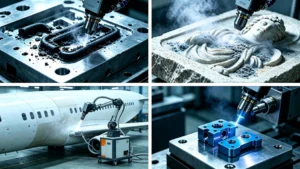
In high-end product identification, luxury branding, and anti-counterfeiting, traditional metal coloration methods like chemical etching or screen printing are rapidly losing ground. These legacy processes pose environmental risks, prone to peeling, and lack the micrometer-level precision required for modern components.
The introduction of MOPA (Master Oscillator Power Amplifier) fiber laser technology has introduced a frictionless alternative: creating permanent, vibrant colors directly on metal without using any inks, pigments, or chemical additives. This guide explains how MOPA technology manipulates laser pulse widths to generate controlled surface coloration and analyzes the current market challenges of this technology.
1. What Is MOPA Technology in Fiber Lasers?
To understand MOPA technology, it is best to think of it as giving a laser machine a highly responsive digital transmission.
In conventional laser systems, every time the laser fires, the pulse characteristics are rigid and uniform. Operators can only change how fast or how powerful the overall beam is, but they cannot alter the shape or duration of the individual light bursts.
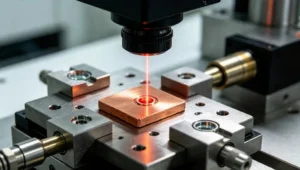
MOPA stands for Master Oscillator Power Amplifier. By separating the laser generation from the power amplification, a MOPA system allows operators to independently adjust both the pulse width (the duration of a single laser burst) and the frequency. It can deliver short, rapid-fire bursts for sensitive work or long, heavy hits for deep engraving. This flexibility provides precise, micrometer-level control over how heat is distributed across a material’s surface.
2. The Science Behind Structural Coloration and Compatible Substrates
Laser color marking does not “paint” the metal; instead, it performs a form of optical magic known as structural coloration.
The Underlying Physics
when a MOPA laser scans a metal surface at high frequencies with ultra-short pulses, it heats the metal within a tightly controlled, superficial zone. This rapid heating causes elements within the alloy to instantly bond with atmospheric oxygen, growing a transparent oxide film that is only tens to hundreds of nanometers thick.
When ambient light strikes this treated surface, an optical phenomenon called Thin-Film Interference occurs:
1.Part of the light reflects off the top layer of the transparent oxide film.
2.The remaining light penetrates the film and reflects off the underlying raw metal base.
3.When these two reflected light waves meet, they interfere with one another, canceling out certain wavelengths and reinforcing others.
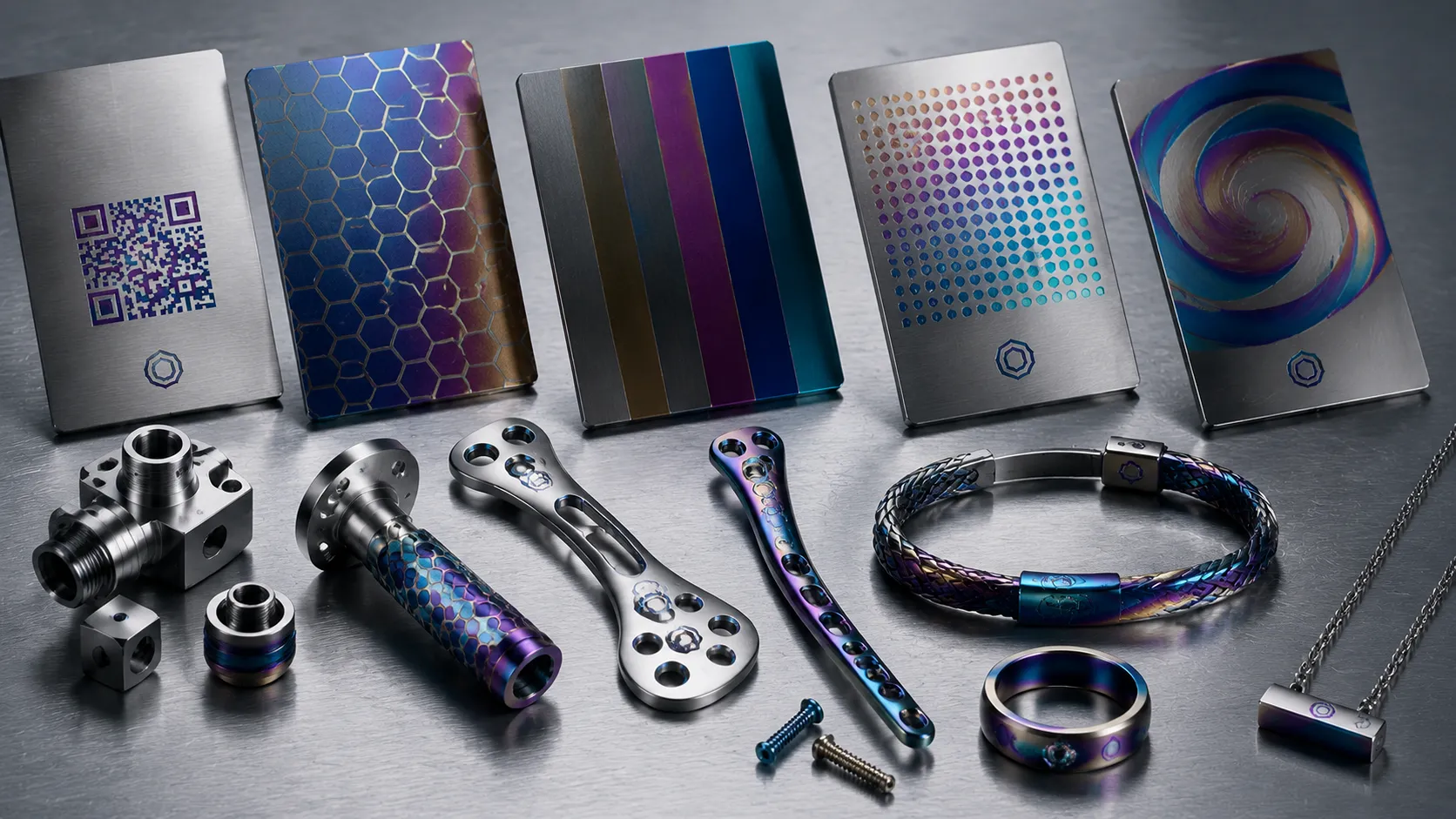
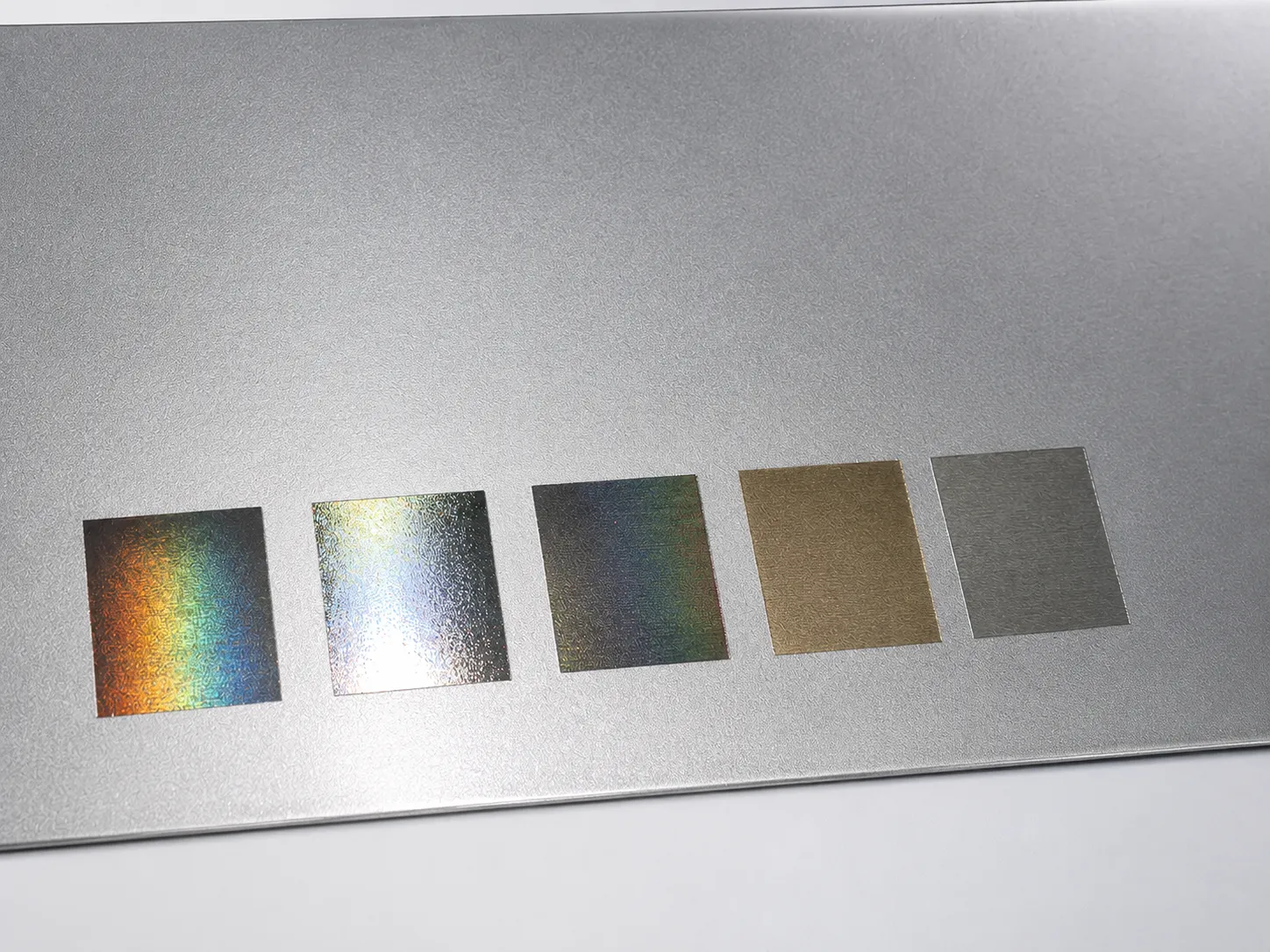
Much like the iridescent colors seen on a soap bubble or an oil slick, this interference creates distinct colors. By shifting the MOPA pulse width, operators alter the heating time, which changes the exact thickness of the oxide layer and alters the reflected color from golds and reds to deep blues and greens.
Compatible Materials
This structural coloration process relies heavily on the specific metallurgical makeup of the substrate. It is highly effective on a selective group of industrial metals:
- Stainless Steel (Particularly 304 and 316 grades): The high chromium and nickel content makes stainless steel the absolute benchmark for laser coloration, yielding the widest and most vibrant color spectrum.
- Titanium and Titanium Alloys: Titanium oxidizes predictably under MOPA pulses, producing highly stable, brilliant colors frequently utilized in medical devices and high-end jewelry.
- Chromium-Plated Metals: Certain industrial hardware parts treated with chrome surfaces can also achieve basic color variations under precise thermal dosing.
3. What Is the Difference Between a MOPA Laser and a Regular Fiber Laser?
For industrial buyers evaluating hardware, choosing between a standard fiber laser and a MOPA system comes down to application demands. Standard fiber lasers (typically utilizing Q-switched technology) act like a heavy-duty pickup truck—rugged, powerful, and built for bulk work. A MOPA laser functions like a high-performance sports car—refined, highly adjustable, and engineered for precision.
| Feature / Trait | Regular Fiber Laser (Q-Switched) | MOPA Fiber Laser |
|---|---|---|
| Pulse Width Control | Fixed (cannot be adjusted; typically long) | Highly flexible (adjustable from 2 ns to 500 ns) |
| Heat-Affected Zone (HAZ) | Relatively large; can warp thin sheets or char edges | Extremely minimal; enables clean, low-heat marking |
| Primary Strengths | Deep metal engraving, heavy scaling removal, bulk serial numbers | Stainless steel coloration, crisp marking on sensitive plastics, stripping anodized aluminum |
| Capital Investment | Budget-friendly; excellent ROI for baseline tracking | Premium pricing; required for advanced aesthetics and custom finishes |
4. Current Technical Bottlenecks Preventing Mass Adoption
While MOPA color marking offers incredible visual appeal, it has not yet completely replaced traditional printing across all mass-production lines. Manufacturers must navigate three clear engineering bottlenecks:
1. Extreme Parameter Sensitivity and Calibration Difficulty
The single greatest hurdle in production environments is that color accuracy is incredibly difficult to capture and lock down through parameters alone. Because a color shift of just 10 nanometers in oxide thickness changes the perceived hue entirely, the “sweet spot” for parameters is razor-thin.
Slight fluctuations in ambient factory temperature, minor focal distance variations, or subtle changes in the laser’s internal power stability can cause a programmed “vibrant blue” to drift into a “faded purple.” Developing a reliable parameter matrix requires extensive trial-and-error, making initial setup highly complex.
2. Sensitivity to Raw Material Consistency
Because the laser relies on drawing chromium and iron to the surface to grow the oxide layer, the process is highly sensitive to the material’s exact batch chemistry.
Two sheets of 304 stainless steel sourced from different suppliers—or even different batches from the same mill—may exhibit microscopic variations in alloy distribution or surface oil residues. These tiny differences alter how the material absorbs laser energy, resulting in noticeable color variations across identical production runs.
3. Production Speed and Throughput Compromises
To build a uniform, micro-layered oxide film without vaporizing the metal, the MOPA laser beam must move at controlled speeds with high overlapping densities. This process takes significantly longer than standard black-and-white laser marking, creating a potential throughput bottleneck on high-speed automated assembly lines.
4. Angle Dependency (Color Shift)
Because the color is created by light wavelengths bouncing through a clear film rather than a fixed chemical dye, the color is naturally angle-dependent. A marked logo that appears deep red when viewed straight-on may shift toward a golden hue when viewed from a sharp angle.
5. Future Development Directions
The engineering challenges surrounding MOPA color marking are actively driving the next generation of industrial hardware innovations:
- AI-Driven Closed-Loop Vision Feedback: Future MOPA platforms are integrating high-resolution inline cameras directly into the marking head. As the laser marks, the vision system scans the color in real-time. If it detects a microscopic color drift due to material variance, the software automatically dynamically scales the pulse width and frequency on the fly to correct the output.
- Broader Material Adaptability: Laser engineers are developing specialized multi-wave pulse profiles to achieve reliable coloration on trickier substrates, such as specific brass alloys and anodized aluminum surfaces.
- Narrowing the Cost Gap: As MOPA laser source manufacturing scales globally, the price premium over legacy Q-switched systems continues to narrow. As hardware costs decline, color laser marking will transition from a premium, niche customization tool into a standard feature for mass consumer product packaging and anti-counterfeiting tracking.
6. Conclusion
MOPA pulse width regulation transforms standard metal marking into an ultra-precise exercise in optical physics. By understanding the boundaries of thin-film interference and accounting for the sensitivity of material batches, procurement and QA teams can successfully deploy MOPA systems to achieve striking corporate branding and permanent traceability that sets their products apart in the global marketplace.