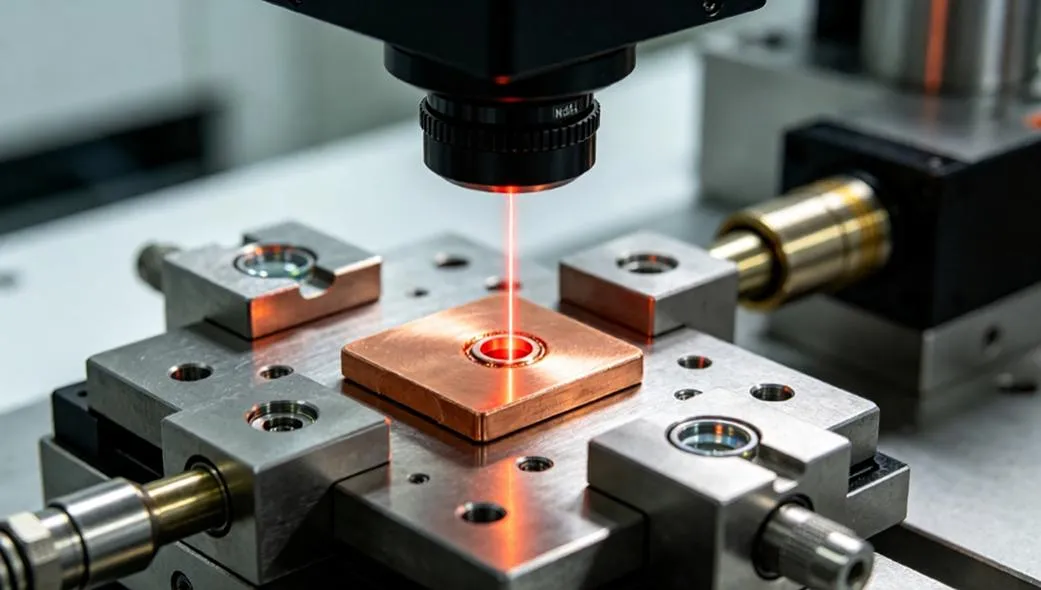
When you’re working on micro parts or heat‑sensitive assemblies, too much power is the enemy—thermal control is what counts. Pulsed Nd:YAG welding puts energy exactly where you need it in short bursts, fusing metal while keeping nearby features cool and stable.
This article gives engineers and workshop owners a clear, nuts-and-bolts look at Nd:YAG: what it is, how it works, why 1064 nm matters, and where it consistently outperforms other sources on the shop floor.
1. Introduction: Why Pulsed Nd:YAG Still Matters in a Fiber-Dominated Market
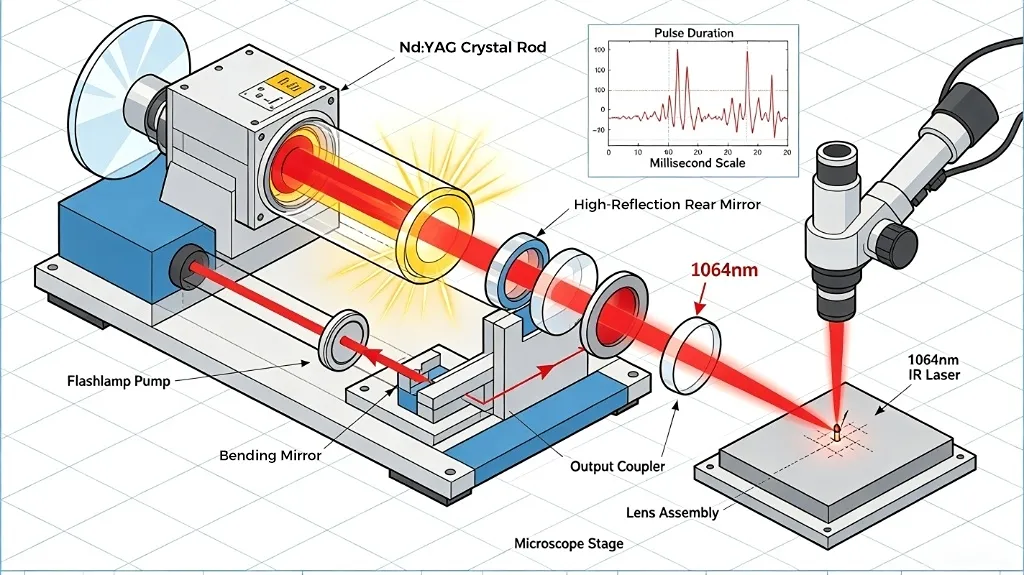
- Nd:YAG stands for Neodymium-doped Yttrium Aluminum Garnet. It’s a solid-state laser where neodymium ions (Nd³⁺) embedded in a YAG crystal generate coherent infrared light at 1064 nm.
- Industry relevance: Continuous fiber lasers excel at long seam welding in sheet metal and structural fabrication. Pulsed Nd:YAG holds its ground for micro-spot welding, delicate jewelry repair near stones, and deep-cavity mold and die restoration where heat control and access are mission-critical.
2. What Does Nd:YAG Mean? Crystal Structure and the 1064 nm Wavelength
- Crystal physics in plain terms: A YAG rod is a synthetic crystal host (Y₃Al₅O₁₂). Neodymium ions are doped into the lattice. When pumped by a flashlamp or diodes, electrons jump to higher energy states and, as they relax, emit photons. Resonator mirrors reinforce emission at 1064 nm.
- Why 1064 nm matters: 1064 nm sits in the near‑infrared. Many industrial metals—steels, titanium, and numerous aluminum alloys—couple well when the surface is clean and the spot is tightly focused. For high‑reflectivity metals like gold, silver, and copper, absorption is low at room temperature; the high peak power of pulsed Nd:YAG is used to pierce the reflective barrier with an initial spike, establish a molten pool, and then maintain stable fusion with controlled pulse energy.
- Pulsed vs. Continuous: Pulsed Nd:YAG stores energy and releases it in bursts. Each pulse delivers high peak power for milliseconds, melting a tiny volume quickly. Continuous-wave (CW) sources provide steady heat and are ideal for long seams but can spread heat into adjacent features on miniature parts.
3. How a YAG Laser Welder Works: The Physics of Pulsed Micro-Fusion
Process flow:
- Pumping: A flashlamp (or diode array) excites Nd³⁺ ions in the YAG crystal.
- Stimulated emission: Photons bounce between resonator mirrors, building a coherent beam at 1064 nm.
- Beam delivery: Optics focus the beam through a microscope or CCD-guided head onto the workpiece.
- Pulse control: The control system shapes pulse width (typically 1–20 ms) and frequency (Hz), setting the delivered energy per pulse and overall heat input.
Peak power vs. average power:
- A single pulse can reach thousands of watts for a few milliseconds while average power remains modest. You achieve rapid local melting without soaking the entire part.
Thermal control in practice:
- Adjust pulse duration, energy (J), and repetition rate to confine the heat-affected zone (HAZ) to a micro footprint. This reduces warping on thin sections, avoids heat tinting on polished surfaces, and prevents damage to nearby adhesives, elastomers, sensors, or gemstones.
For jewelry repair and other precision micro-welding applications, our YAG jewelry laser welder provides controlled spot welding for gold, silver, platinum, titanium, and other precision metal components.
4. Key Properties That Make Nd:YAG Irreplaceable for Micro-Welding
- Ultra-small HAZ: Short pulses deposit energy quickly and locally. Watch movements, micro-electronics, thin foils, and jewelry near stones stay cool and dimensionally stable.
- Peak power flexibility: High peak power overcomes initial reflectivity on copper, silver, and gold—initiate the melt with a sharp front edge, then tailor penetration via pulse shaping.
- Microscope/CCD integration: High magnification, crosshairs, and steady hand rests enable micron-level aim for repeatable dots, bridges, and overlay cladding.
- Precise energy metering: Joules-per-pulse and spot size control bead width and depth per shot. Save parameter recipes for consistent results across shifts.
5. Core Industrial Applications: Where Nd:YAG Lasers Excel
- Fine Jewelry Repair & Manufacturing:
- Re-tipping prongs next to heat-sensitive stones
- Sizing rings and repairing chains with polished finishes
- Adding small amounts of alloy with controlled dots or short stitches
- Injection Mold & Die Restoration:
- Rebuilding worn edges and parting lines with pinpoint overlay, dot-by-dot
- Filling micro-cracks and accessing deep cavities using articulated heads and long working distance optics
- Precise build-up on the parting line and inside deep grooves without annealing and without distortion; maintain cavity geometry while restoring sharp edges and sealing hairline defects
- Medical Devices & Micro-Electronics:
- Spot welding pacemaker housings and thin instrument joints
- Joining fine wires, leads, and sensor housings
- Clean fusion near plastics, seals, and electronics with minimal spatter
- Precision Hardware & Horology:
- Watch case and bracelet repairs, tiny hinge points
- Dental prosthetics and small instrument adjustments
- Pinpoint overlays on fixtures and precision mechanisms
6. Nd:YAG vs. Fiber Lasers: Knowing When to Choose YAG
| Metric | Pulsed Nd:YAG Laser | Continuous Wave (CW) Fiber Laser |
|---|---|---|
| Primary Energy Mode | High peak-power pulse bursts (ms-scale) | Continuous, uninterrupted beam |
| Ideal Joining Type | Micro spot welds, dot-by-dot build-up, overlay cladding | Long continuous seam welds and high-speed production paths |
| Heat Impact (HAZ) | Microscopic/near-zero; tightly confined | Moderate to controlled; wider thermal footprint on small parts |
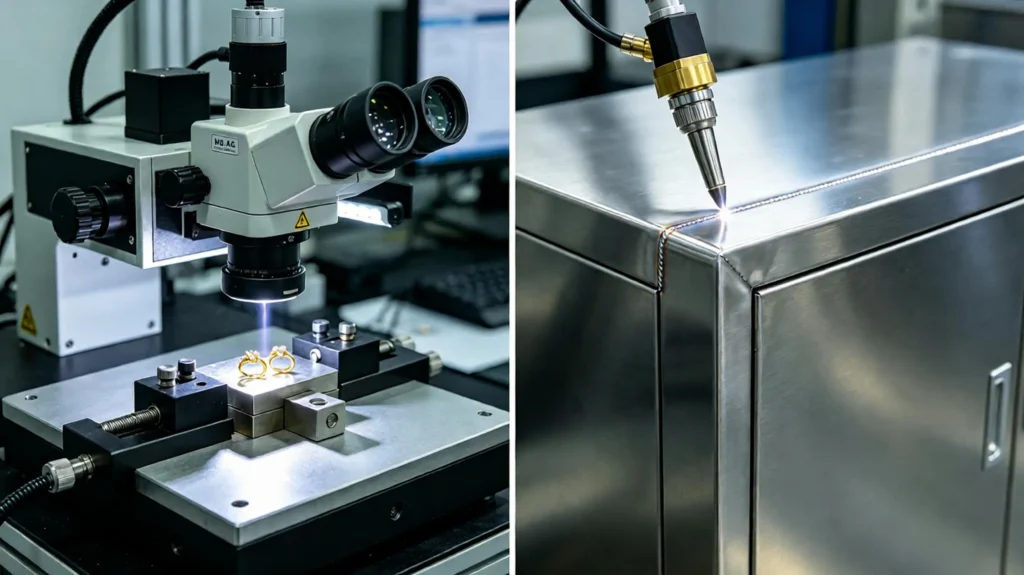
| Best Use Cases | Jewelry repair, mold/die rebuilding, precision micro-parts | Sheet metal cabinets, pipes, structural frames, long seams |
| Typical Optics & Ergonomics | Microscope/CCD, hand rests, enclosed chamber | Scan heads or handheld/gantry nozzles, open cells or guarded booths |
| Penetration Control | Pulse shaping (J, ms, Hz) for depth per dot | Travel speed and CW power for continuous penetration |
7. Conclusion: Precision Thermal Control with ONS LASER
Pulsed Nd:YAG isn’t old tech—it’s the right tool when joints are tiny, materials are reflective, or access is tight. If your workflow touches micro-fusion on precious metals or deep mold cavities, 1064 nm pulses with microscope guidance deliver clean, repeatable welds while protecting the surrounding assembly.
Why teams choose ONS LASER for Nd:YAG and precision welding:
- Direct Factory Pricing & OEM/ODM: Configure optics, fixtures, software, and ergonomics without middleman markups.
- Local German Warehouse & Hub: Duty-paid inventory and fast European shipping; German showroom for live demos and hands-on sample trials.
- 100% Pre-Calibrated & Ready to Run: Fully assembled and optically aligned—up and welding in under 10 minutes after uncrating.
- Full Laser Spectrum Expertise: Nd:YAG, Fiber, MOPA, CO2, and UV in-house. We recommend the right source for your materials and part mix.
Ready to test on your parts? Send delicate components or worn molds to the ONS LASER application lab. We’ll run free pulse-parameter trials, provide microscopic weld inspections and HD video, and return clear equipment recommendations and cycle-time data.
Contact ONSLASER Application Engineers for Free Testing & Quote