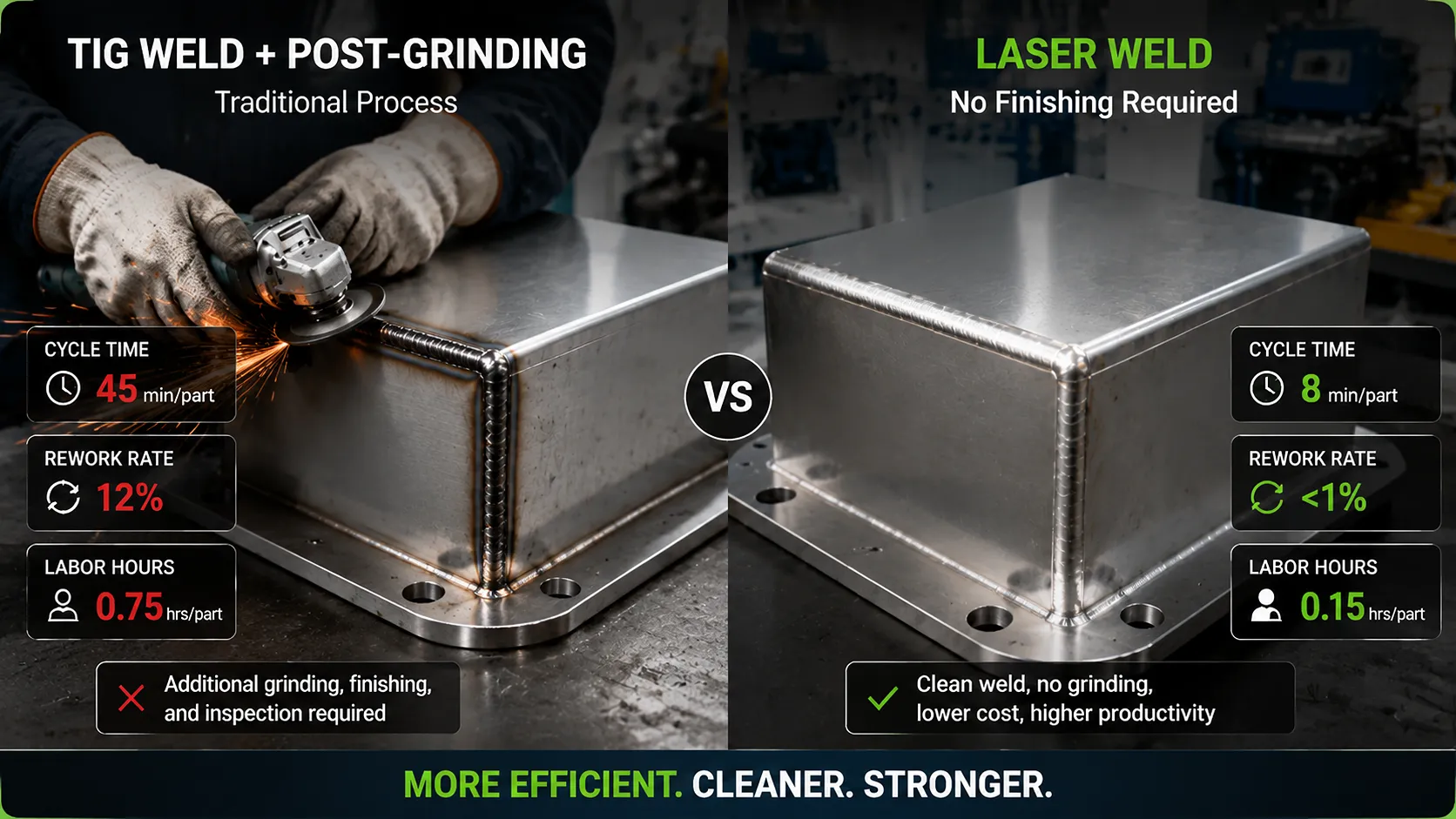
If you still think laser welding is just “fancy TIG,” your production metrics are leaving money on the table. Modern fiber laser welders replace legacy TIG/MIG in two critical ways: they cut total cycle time and they slash post-processing. By tuning scan speed, power density, spot size, and oscillation, one machine can deliver either flawless cosmetic seams on thin stainless or deep, structural fusion on thick sections—without retooling.
Think of a fiber laser as a smart scalpel. With a few parameter tweaks, it switches from a “gentle touch” for clean, shallow seams to a “power driver” that delivers full-penetration joints, all on the same workstation. No torch changes. No gas cup swaps. No operator gymnastics.
1. One Machine, Two Welding Modes: The Versatility of Fiber Laser Welders
- TIG/MIG force you to choose between edge cosmetics, distortion control, and penetration. Fiber laser welders do all three by modulating power density and beam interaction with the material.
- The “smart scalpel” idea: adjust focus, travel speed, and beam oscillation to glide in conduction mode for smooth surface fusion, then ramp peak power and reduce speed to open a stable keyhole for deep penetration—no hardware swap.
- Results on the floor:
- Tight seams with zero or near-zero grinding.
- Heat input control that prevents blow-through on thin stock.
- Single-pass full penetration on thicker joints with narrow beads and minimal distortion.
2. Conduction Mode: Seamless, Aesthetic Welds with Zero Post-Processing
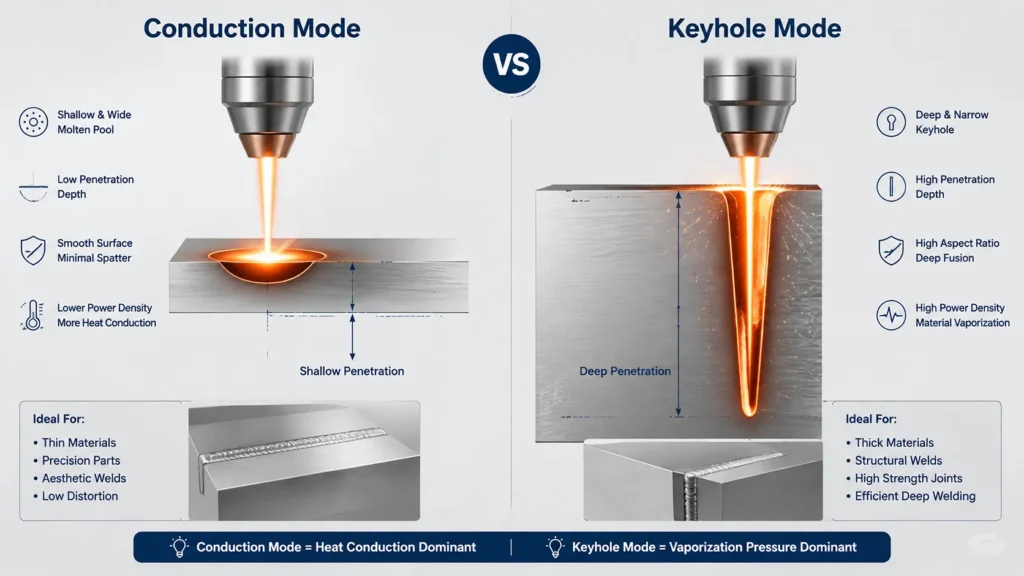
Conduction mode is like warming butter with a hot knife. The beam heats the surface and energy conducts downward. There’s no vapor cavity; the pool is shallow and stable. That stability is what gives you clean, cosmetic seams.
Commercial value drivers:
- Zero grinding/polishing: Flush, spatter-free seams reduce finishing time by up to 70%.
- Blow-through prevention on thin sheets: Ideal for 0.5–1.5 mm stainless and similar gauges.
- Reduced fixturing: Low distortion means lighter clamps and faster changeovers.
Typical applications:
- Stainless steel enclosures and corner seams
- Kitchenware and appliances (cosmetic outer shells)
- Medical hardware and instruments
- Electronic chassis and architectural trims
Practical setup pointers:
- Use lower peak power, higher travel speed, and wider wobble for a broader, flat bead.
- Slight defocus (+) can widen the spot and soften heat input.
- Shielding gas: Argon or nitrogen for stainless; maintain a clean trailing shield for color control.
Pro-Tip: Using Nitrogen for stainless steel preserves corrosion resistance, while Argon prevents oxidation on carbon steel and aluminum.
3. Deep Penetration (Keyhole) Mode: Industrial-Grade Strength in a Single Pass
Keyhole mode forms a narrow vapor cavity that drives energy deep into the joint—this is your single-pass, full-penetration solution. Instead of beveling, stacking passes, and grinding, you run once and move on.
Commercial value drivers:
- Single-pass full penetration: Eliminate beveling and multiple TIG passes.
- Narrow weld seam, minimal distortion: Less rework, tighter tolerances in downstream assembly.
- Stable mechanical properties: High aspect ratio welds with consistent fusion.
Typical applications:
- Structural automotive parts and subframes
- High-pressure tubing and manifolds
- Thick plate butt joints and fillets where strength is critical
Practical setup pointers:
- Increase power density (tight focus, sufficient power), reduce travel speed to stabilize the keyhole.
- Wobble head with small amplitude helps stabilize the cavity and bridge gaps.
- Backing bars or inert gas purging (for tubes) keep root quality clean.
Pro-Tip: Using Nitrogen for stainless steel preserves corrosion resistance, while Argon prevents oxidation on carbon steel and aluminum.
4. Continuous (CW) vs. Pulsed (QCW) Lasers: Matching Waveforms to Prevent Material Burn-Through
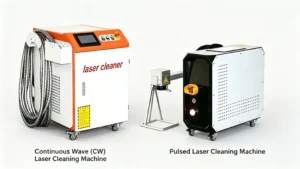
CW (continuous wave) delivers a steady stream of energy—great for long, fast seams and predictable penetration on typical gauges. Pulsed or QCW (quasi-continuous wave) provides high-peak-power bursts with cooling intervals, ideal for ultra-thin foils and reflective metals.
- CW: Think “steady water hose.” It lays down consistent energy for continuous seams in 0.8–6 mm material. Best when speed and uniformity matter.
- QCW/Pulsed: Think “controlled hammer taps.” Short, intense bursts create penetration without allowing heat to accumulate. Crucial for:
- Ultra-thin foils (<0.8 mm): Prevents hot spots and blow-through.
- Highly reflective metals (Al, Cu, brass): High peak power improves coupling while pauses limit heat buildup and hot cracking.
- Spot and stitch welds on thermal-sensitive assemblies.
Integration tips:
- For Al/Cu, combine QCW with oscillation to spread energy and mitigate hot cracking.
- Start with shorter pulse widths and higher peak power; tune duty cycle to balance penetration and heat input.
- Pre-clean and fit-up matter more on reflective metals; add back-reflection protection for optics safety.
5. The Business Case: How Fiber Lasers Boost Your Shop Floor ROI
- Low Skill Barrier: Wobble head technology and onboard presets let a new operator hit “pro-level” aesthetics in about two hours. Reduced dependence on scarce master welders.
- 4×–10× Faster than TIG: Continuous seams at high travel speeds with minimal stoppage. Less heat means fewer fixtures and faster part handling.
- Near-100% First-Pass Yield: Tiny HAZ reduces warp and rework. More parts meet spec without grinding, polishing, or straightening.
- Lower Total Cost per Part: Fewer consumables, less abrasive use, and minimal downstream finishing add up quickly on multi-shift operations.
6. Quick Selection Guide: Matching Your Material to the Right Weld Mode
| Substrate Type & Thickness | Recommended Mode | Waveform | Primary Benefit |
|---|---|---|---|
| Stainless 0.5–1.5 mm (lap/corner) | Conduction | CW | Cosmetic seam, zero grinding, no blow-through |
| Stainless 2–4 mm (butt/fillet) | Keyhole (deep penetration) | CW | Single-pass penetration, minimal distortion |
| Aluminum 0.8–2 mm (butt/lap) | Conduction to shallow keyhole | CW with Wobble (Standard) or QCW (For Ultra-Thin) | Prevent hot cracks, stable pool on reflective surface |
| Copper/Brass 0.5–1.5 mm (tabs/busbars) | Conduction | QCW | High peak power for coupling, avoids burn-through |
| Carbon Steel 2–8 mm (butt) | Keyhole | CW | Narrow, deep fusion with reduced beveling |
| Thin Foils <0.8 mm (SS/Al/Cu) | Conduction (low heat) | QCW | No blow-through, tight heat control |
| Tubing (SS/CS) 1–3 mm wall | Keyhole | CW | Full-depth root with stable speed; minimal post-process |
| Cosmetic outer panels (SS/Al) | Conduction | CW | Aesthetic welds, zero or minimal finishing |
Notes:
- Wobble amplitude and frequency fine-tune bead width and gap bridging.
- For reflective alloys, ensure surface prep and consider helium/argon mix for porosity control.
7. Optimize Your Weld Quality with ONS LASER Application Engineering
When you buy a fiber laser welder, you’re buying a welding process—not just a box. That’s where ONS LASER stands out:
- Direct Factory Pricing & OEM/ODM
- Built and configured at the source with no middleman markup. We tailor hardware, software, fixtures, vision, and safety enclosures to your line, including MES and conveyor integration.
- Local German Warehouse & Hub
- Duty-paid stock and a German showroom for live demos and hands-on trials. Faster shipping and spares across Europe, less downtime waiting for parts.
- 100% Pre-Calibrated & Ready to Run
- Fully assembled, aligned, and parameter-checked before dispatch. Uncrate and start welding in under 10 minutes—no beam alignment headaches.
- Full Laser Spectrum Expertise
- Fiber, MOPA, CO2, UV, and YAG under one roof. You get unbiased, materials-first recommendations for welding, cutting, or marking as your product mix evolves.
Want proof on your parts? Send us your exact materials and joint designs. Our application lab will run:
- Free sample welding with microscopy and metallographic cross-sections
- Parameter sheets for both conduction and keyhole modes
- Cycle-time and takt analysis for your production plan
Ready to remove grinding from your workflow and stabilize first-pass yield?
Contact ONSLASER Application Engineers for Free Testing & Quote.