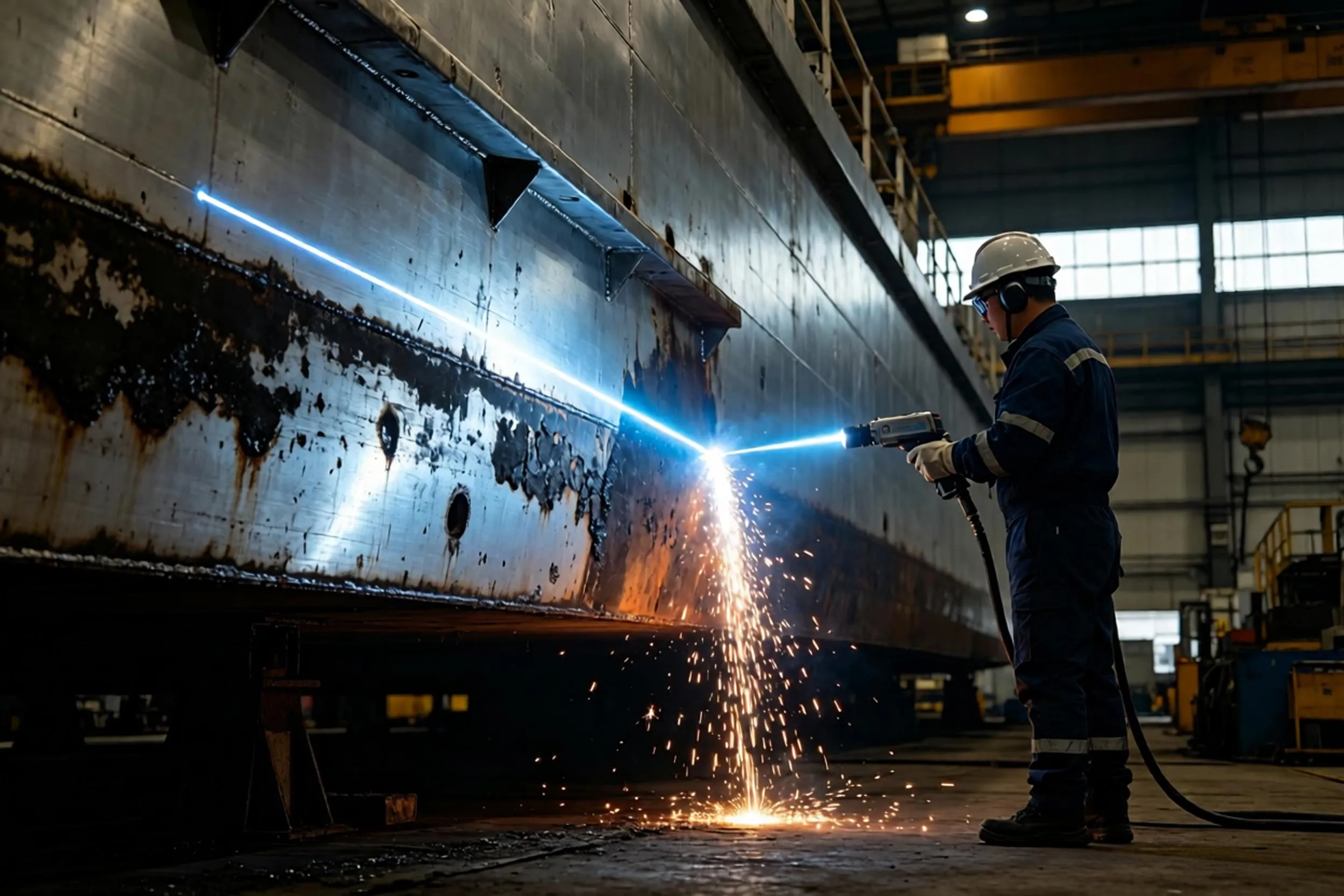
Steel yards and dry docks face a simple math problem: tighter environmental limits, fewer skilled blasters, and high daily docking fees. Sandblasting moves material, but it also brings tons of media, slurry cleanup, and rework risk. Multi‑kilowatt continuous wave (CW) fiber lasers give shipyards a clean, dry way to remove heavy rust, mill scale, and marine epoxies—without grit or runoff.
This article is for operations leaders and maintenance managers evaluating the next equipment cycle. We explain why CW fiber cleaning fits structural steel, where it beats blasting in square‑meters per shift, and how it pays back through lower consumables and faster handover to coating. As a reference point, a 3 kW CW unit typically achieves 15–20 m²/h on Grade‑B rust (shipyard prep standard), 8–12 m²/h on thick mill scale, and 6–10 m²/h on marine epoxy systems, with surface temperature dwell times held to milliseconds per pass using high scan speeds and wide fields.
1. Executive Summary & Industry Pain Points
Traditional de-rusting in shipyards carries a heavy compliance load. Grit blasting consumes large volumes of abrasive and generates contaminated waste that must be collected, transported, and disposed of. Chemical stripping adds its own steps—masking, neutralization, wastewater treatment—and increases handling risks. Rework is common: grit embedment at weld toes, over‑profiling that pushes roughness outside coating specs, and extra polishing or reblasting. CW fiber laser cleaning removes these bottlenecks by using steady optical power to thermally break down corrosion and coatings. In day‑to‑day operations, a 2 kW CW setup can clear 10–14 m²/h of Grade‑B rust or 5–8 m²/h of epoxy on AH36/DH36 plate; 3 kW raises those rates by roughly 30–40% under similar standoff and overlap. Because the process is dry and targeted, staging and containment are simpler, and teams convert more of the shift into productive cleaning time.
Multi‑kilowatt CW fiber lasers have matured into reliable shop tools. Power trains at 1.5–3 kW with industrial scan heads run continuously, handle wide fields, and pair well with mobile extraction. The result is consistent removal tracks and repeatable throughput. Less time lost to media logistics and enclosure setup translates directly into fewer hours in dock. For most hull and ballast tank work, the practical advantage is not a promise—it shows up as fewer shifts and faster handover to coating crews.
2. Physical Advantage: Why CW Fiber Lasers Fit Heavy Steel Best
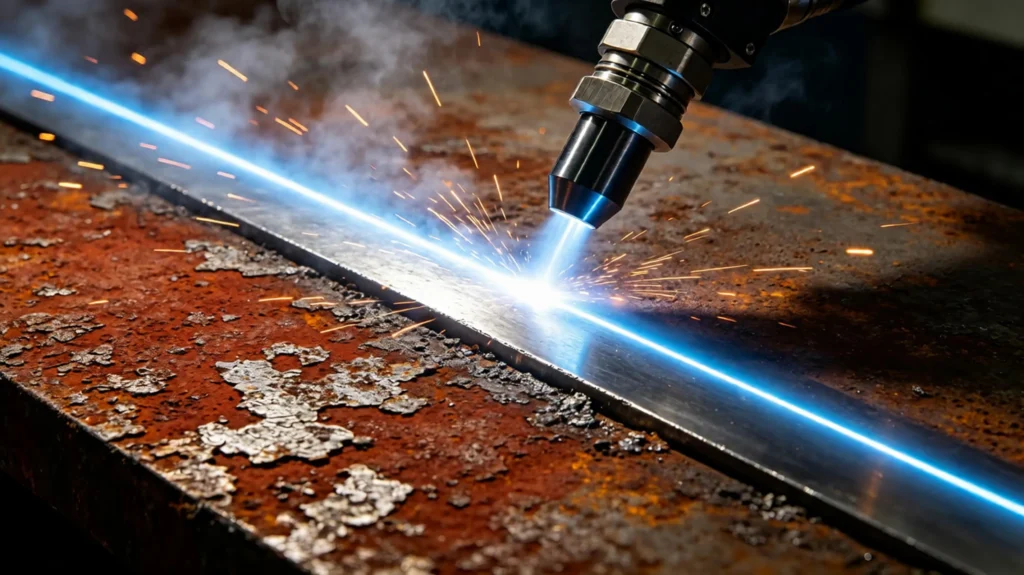
CW cleaning uses continuous thermal input to drive off rust layers, marine epoxies, and mill scale. Instead of short photoacoustic bursts, the beam keeps the contaminant at removal temperature while the scan head moves quickly. With the right overlap and fume capture, the plume stays stable, removal is even, and lane widths can extend to 150–300 mm depending on optics.
Structural shipbuilding steels such as AH36 and DH36 have enough thermal mass to handle CW cleaning without distortion when scan speed and overlap are set correctly. The heat‑affected depth remains shallow because the beam keeps moving; measured surface temperature stays elevated only for milliseconds per pass, and the bulk plate stays close to ambient. This preserves geometry and avoids the warping risk associated with slow, localized heating.
Marine epoxy coatings and heavy mill scale respond well to multi‑pass strategies. The first pass softens and depolymerizes epoxy systems; follow‑up passes lift residues and break through scale. Because there is no grit impact, there is no micro‑peening or media embedment, and the cleaned surface remains uniform—ideal for primer adhesion. On thick scale, a 3 kW unit with a 0.2–0.4 mm spot equivalent and high traverse speeds typically clears 8–12 m²/h; on epoxy/antifouling stacks, expect 6–10 m²/h depending on thickness and pigment.
3. Core Application Scenarios in Shipbuilding & Marine Engineering
- Ship Hull & Ballast Tank Heavy De-Rusting
Hull plating, frames, and stiffeners accumulate layered corrosion. CW systems remove Grade‑B rust in broad lanes with controlled heat input and minimal staging. In ballast tanks and confined holds, portable extraction manages particulate at the source. - Marine Grade Coating & Anti-Fouling Epoxy Paint Stripping
Aged antifouling coatings and primers come off in defined tracks. Crews avoid rebound and ricochet hazards common with blasting, and masking complexity around valves and cables is reduced. - Automated Pre-Weld Joint Cleaning for Heavy Plate Fabrication
Mount CW scan heads on gantries or cobots to prep bevels and root faces quickly. Clean, oxide‑free joints reduce porosity and stabilize the arc. Consistent bead quality pays back in less rework. - Offshore Oil Platforms & Port Infrastructure Maintenance
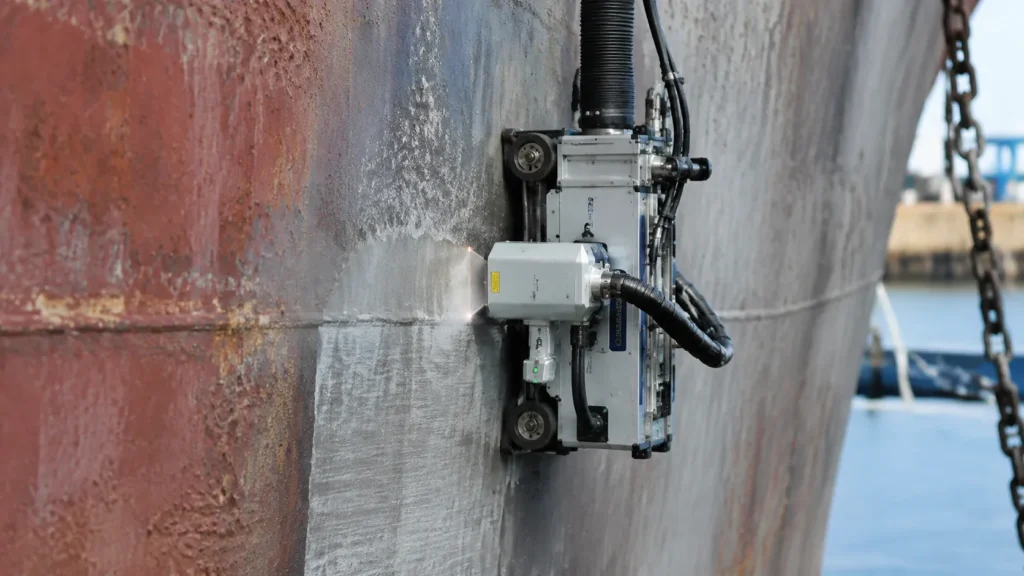
CW laser heads integrate with magnetic crawlers for vertical surfaces—risers, jackets, quay walls. This cuts scaffolding time and keeps crews off high‑angle work while maintaining steady standoff and overlap.
4. Performance & ROI Comparison: CW Laser vs. Sandblasting & Chemical Cleaning
| Criteria | CW Fiber Laser Cleaning | Sand/Grit Blasting | Chemical Cleaning |
|---|---|---|---|
| Throughput on heavy rust/scale | 3 kW: 15–20 m²/h (Grade‑B rust); 8–12 m²/h (mill scale); 6–10 m²/h (marine epoxy) | High nominal rate but reduced by containment, recovery, and media changeouts | Moderate; multiple steps and dwell times |
| Consumables | Filters for fume extraction; no abrasive media | High media usage (tons per project), nozzles, hoses | High chemical consumption, neutralizers, PPE |
| Secondary waste | Dry particulate in filters, compact waste stream | Large volumes of spent media and sludge | Hazardous liquid waste, neutralization byproducts |
| Surface integrity | No media embedment; controlled heat, uniform tracks | Risk of embedment and over‑profiling | Risk of undercutting and inconsistent surface |
| Labor safety | Lower noise and rebound hazards; lighter PPE | High PPE, rebound/visibility issues, line‑of‑fire risks | Chemical exposure and handling risks |
| Setup and mobility | Quick deployment; lighter containment and zoning | Heavy containment and recovery systems | Extensive masking and post‑wash |
| Automation readiness | Strong fit for robotic scanners and crawlers | Limited by media flow, nozzle wear | Limited by liquid handling and runoff |
Consumables and secondary waste management matter at dock scale. CW lasers remove the abrasive stream entirely. Extraction filters become the main consumable and are swapped on a schedule, resulting in predictable, compact waste. This simplifies logistics and reduces environmental risk at the quay.
Operator safety improves in practical ways. There is no media rebound clouding visibility, and acoustic levels are lower than blasting rigs. PPE is still required for laser and fume safety, but the physical strain of handling heavy hoses and blast pots is gone. Crews spend more time guiding the scan path and less time fighting equipment.
Base metal integrity is maintained because there is no grit embedment and no unintended cold work. With correct scan speeds and overlap, heat tint is minimal, and microstructure stays intact. Coatings adhere well to the uniform surface left by CW cleaning.
From a cost perspective, the capital outlay is offset by savings on media, waste disposal, staging time, and rework. In a typical dry‑dock with steady utilization, shops see payback in 12–24 months. For example, replacing a two‑nozzle blasting shift on hull maintenance with a 3 kW CW system can cut consumables by 70–90% and reduce total cleaning hours by 20–30% once crews are trained and routes are optimized.
5. Future Outlook: The Next Era of Green Shipyard Maintenance
Magnetic crawling robots paired with CW heads are already cleaning vertical hull sections and underbellies with steady standoff and path control. This setup avoids scaffolding and brings repeatable overlap, which lifts hourly throughput and uniformity.
Power levels are climbing. Systems in the 5–10 kW class will open wider lanes and faster traverses, pushing square‑meter rates further for heavy rust, thick mill scale, and epoxy stacks. Cooling and optics are scaling with them, keeping the units field‑practical.
Regulatory pressure is not easing. Dry, media‑free cleaning supports stricter IMO‑aligned particulate and wastewater limits and strengthens ESG reporting. European dry docks moving to CW cleaning reduce discharge risk and streamline audits while keeping production schedules tighter.
6. Conclusion & Next Steps
Strategic Advantage of Modernizing Your Shipyard Fleet
Upgrading to CW fiber laser cleaning is a direct way to cut downtime and waste. For AH36/DH36 plate with heavy rust, mill scale, and marine epoxy, continuous power delivers lane widths and scan speeds that translate into more square meters per shift. The process is dry, setup is simpler, and handoff to coating is faster. In busy docks, those hours add up quickly.
Ready to Benchmark CW Against Your Blasting Costs?
Switching from dry blasting to kilowatt-class fiber lasers isn’t just an equipment purchase; it’s a structural change in your dry-dock logistics. At ONS LASER, we prove performance before you take delivery. Ship us a section of your corroded hull plate or marine-coated coupon—our application lab in Germany will run a free trial, deliver high-res before/after microscopy, and provide a detailed rate model mapped against your local labor and electricity costs.
Contact ONSLASER Application Engineers for Free Sample Testing & ROI Model.