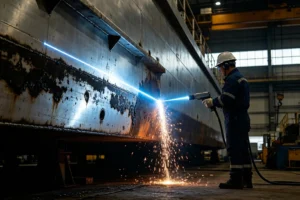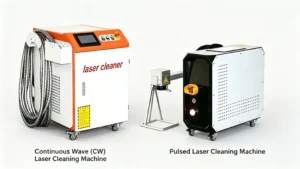
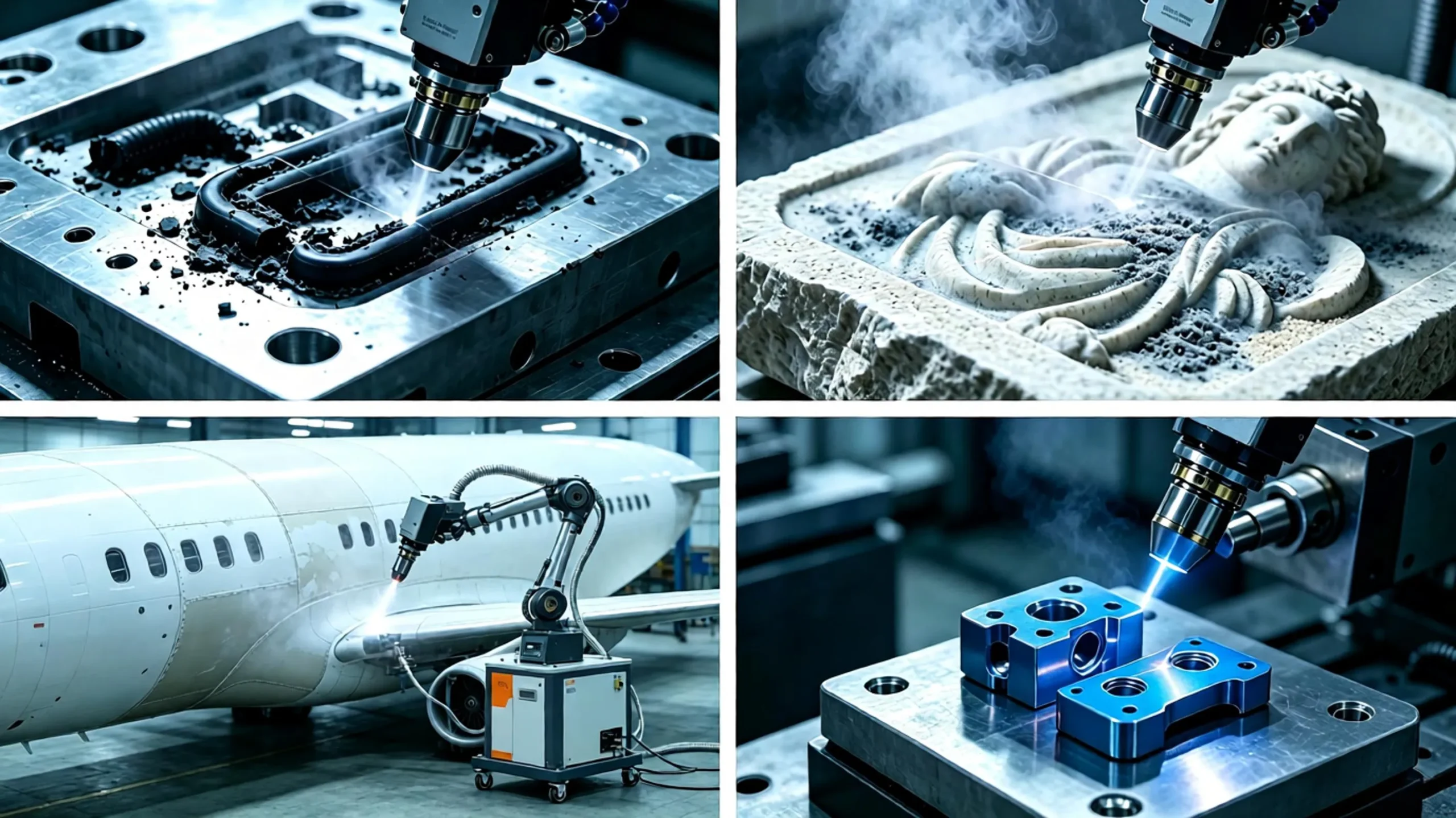
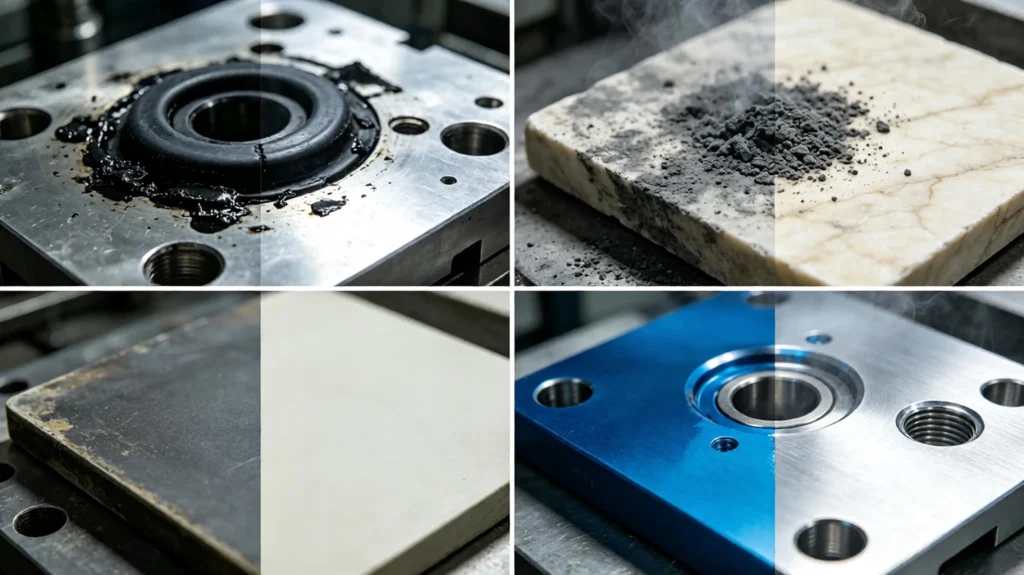
Most shops still think “laser cleaning = rust removal.” That’s only part of the story. With the right nanosecond pulsed settings—and, in some cases, CW for brute throughput—you can lift polymers, paints, oils, and even fragile surface layers without chewing up the base material. If you’re cleaning injection molds one day and historic stone the next, you don’t need a new machine for every job; you need the correct source type and parameter window.
Here are the practical parameters and source selections we’ve validated in our application lab for seven non-standard materials.
1. Introduction: Breaking the “Rust-Only” Laser Cleaning Myth
- Laser ablation isn’t just for iron oxide. Nanosecond fiber lasers deliver high peak power in short bursts (typically 10–500 ns), hitting the contaminant with an energy spike that vaporizes the layer and drives it off with a photoacoustic shockwave—before heat can soak into the substrate.
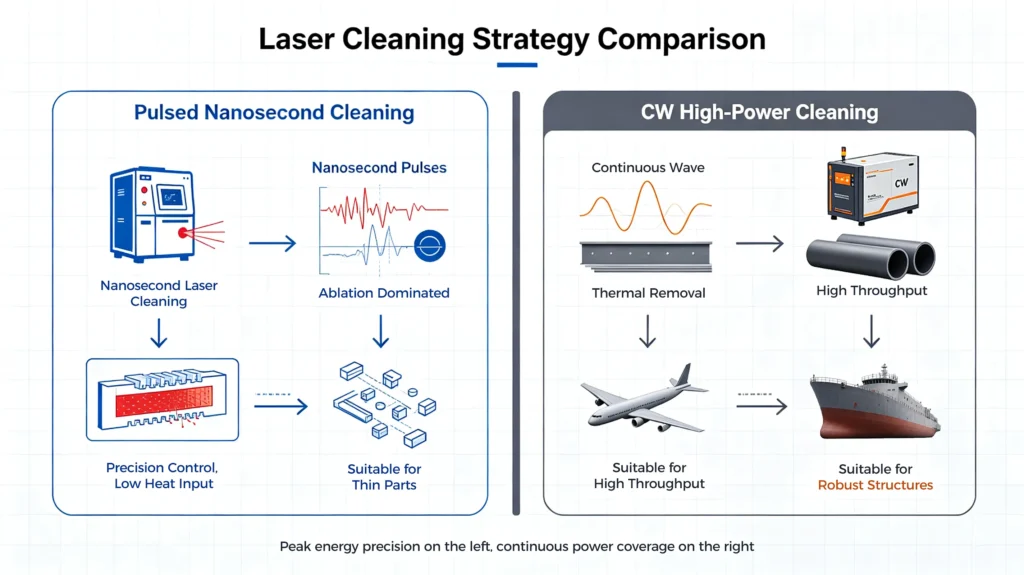
- The trick is matching pulse energy, fluence, and scan strategy to the layer you want gone. For heavy coatings on thick steel, CW (kilowatt class) makes sense. For polymers, paints, and delicate substrates, compact pulsed units do the job with far tighter thermal control.
2. 7 Non-Standard Materials Transformed by Fiber Laser Cleaning
2.1 Material 1: Vulcanized Rubber & Polymer Residues (Injection & Tire Molds)
Recommended System: 200W–300W Compact Pulsed Laser Cleaner
- Typical problem: carbonized rubber flash, mold-release buildup, and polymer residues clogging vents and texturing, causing part ejection issues and cosmetic defects.
- Why laser: Nanosecond pulses (10–200 ns), moderate fluence, and fast scanning break the residue with photoacoustic shock while preserving EDM textures and sharp parting lines.
- Starting window:
- Wavelength: 1064 nm fiber
- Pulse width: 50–150 ns (MOPA optional if available)
- Fluence: 0.5–2.5 J/cm²
- Repetition rate: 20–80 kHz
- Notes: Keep passes quick; use long focal length for even energy on 3D geometry.
2.2 Material 2: Soot, Algae & Pollution on Historic Stone & Statuary
Recommended System: 100W–200W Low-Fluence Portable Pulsed Laser Cleaner
- Typical problem: soot, black crusts, biological growths, and urban pollution films on limestone/marble where patina and tool marks must be preserved.
- Why laser: Low-fluence nanosecond pulses lift contaminants with minimal micro-cracking risk, relying on differential absorption and photoacoustic lift rather than heating the stone mass.
- Starting window:
- Pulse width: 80–200 ns
- Fluence: 0.2–0.8 J/cm² (test on small area first)
- Repetition rate: 30–100 kHz
- Notes: Use wide scan fields and keep dwell time short; avoid stationary beams.
2.3 Material 3: Aerospace Composite Surface Coatings & Aircraft Paints (CFRP / GFRP)
Recommended System: 300W–500W MOPA Pulsed Laser Cleaner (Adjustable Nanosecond Pulse Width)
- Typical problem: topcoats, primers, and adhesives on carbon/glass fiber laminates where resin and fibers must not be thermally damaged.
- Why laser: MOPA control (10–300 ns) tailors peak power to eject paint layers and primers without delaminating or scorching the laminate.
- Starting window:
- Pulse width: 20–100 ns for topcoats; 80–200 ns for primers
- Fluence: 0.3–1.5 J/cm²
- Repetition rate: 50–200 kHz
- Notes: Use fast scan speeds and multiple light passes; monitor substrate temperature.
2.4 Material 4: Pre-Weld Oxide Layers on Non-Ferrous Metals (Aluminum, Copper, Titanium)
Recommended System: 300W Pulsed or 1500W–2000W CW Laser Cleaner (depending on sheet thickness)
- Typical problem: stubborn oxides and shop films that hinder wetting and increase porosity in welds.
- Why laser: Pulsed (10–200 ns) removes thin oxides with minimal heat tint; CW at 1.5–2 kW improves throughput on thick plate or large areas when finish sensitivity is lower.
- Starting window (pulsed, thin sheets/precision parts):
- Pulse width: 30–120 ns
- Fluence: 0.5–2.0 J/cm²
- Repetition rate: 30–100 kHz
- Starting window (CW, heavy plate/large zones):
- Power: 1.5–2.0 kW
- Scan speed: high, with overlap tuned to avoid substrate discoloration
- Notes: Always follow with a clean gas purge or wipe to remove loose debris.
2.5 Material 5: Charred Varnish & Soot on Hardwood & Architectural Timber
Recommended System: 200W Compact Pulsed Laser Cleaner (with wide scan field & low repetition rate)
- Typical problem: smoke damage, aged varnish, or surface soot where grain and edges must be preserved.
- Why laser: Short pulses (10–100 ns) at low fluence strip the brittle char/varnish while keeping substrate temperature low enough to prevent scorching.
- Starting window:
- Pulse width: 20–80 ns
- Fluence: 0.2–0.8 J/cm²
- Repetition rate: 10–40 kHz (with wide scan field to spread heat)
- Notes: Keep motion constant; verify color shift on a hidden spot first.
2.6 Material 6: Release Agents & Grease on Food-Grade Stainless Steel & Industrial Baking Trays
Recommended System: 200W–300W Compact Pulsed Laser Cleaner
- Typical problem: polymerized oils and release agents on 304/316 surfaces that aren’t safe to blast.
- Why laser: Nanosecond pulses crack and vaporize organic layers; stainless base remains bright without grit embedment.
- Starting window:
- Pulse width: 30–120 ns
- Fluence: 0.4–1.2 J/cm²
- Repetition rate: 30–100 kHz
- Notes: Use fume extraction; clean to a uniform, matte sheen for reliable inspection.
2.7 Material 7: Anodized Coatings & Thermal Spray Residues on Delicate Components
Recommended System: 100W–300W MOPA Pulsed Laser Cleaner
- Typical problem: thin anodized layers or overspray on precision components where dimensional integrity is critical.
- Why laser: MOPA lets you dial pulse width and peak power to lift the layer in controlled steps, protecting edges and surface finish.
- Starting window:
- Pulse width: 10–80 ns (shorter for harder anodize)
- Fluence: 0.6–1.5 J/cm²
- Repetition rate: 50–200 kHz
- Notes: Work in multiple light passes with cross-hatch scans; avoid dwell.
3. The Science of Substrate Protection: Why Laser Ablation Works Beyond Metals
- Nanosecond pulses (10–500 ns) deliver high peak power that pushes the contaminant above its ablation threshold quickly. The short duration limits thermal diffusion into the base.
- Photoacoustic shockwave: rapid heating creates a pressure front and micro-plasma that mechanically drives the layer off once it’s flash-vaporized. That’s the key to preserving textures, edges, and micro-geometry.
- Selective absorption: coatings and organics often absorb at 1064 nm more readily than clean metals or stone, giving a natural process window.
- Control knobs that matter:
- Pulse width (ns): shorter = higher peak power for the same pulse energy.
- Fluence (J/cm²): set just above the ablation threshold for the layer you’re removing.
- Repetition rate (kHz) and scan speed: manage average heat input and avoid dwell.
- Spot size and overlap: tune removal uniformity without overexposing edges.
4. Matching the Material to the Laser: Pulse vs. CW Selection Matrix
| Material/Layer | Substrate Sensitivity | Recommended Source | Why It Works |
|---|---|---|---|
| Rubber & polymer residues on molds | High (sharp edges, EDM textures) | 200–300 W Nanosecond Pulsed | High-peak pulses and photoacoustic lift remove residue without rounding |
| Soot/algae on historic stone | Very high (patina, inscriptions) | 100–200 W Low-Fluence Pulsed | Low fluence with fast scans preserves stone microstructure |
| Paints on CFRP/GFRP | Very high (resin/fiber integrity) | 300–500 W MOPA Pulsed | Adjustable ns pulses eject coatings without delamination |
| Pre-weld oxides on Al/Cu/Ti | Medium to high (depends on gauge) | 300 W Pulsed or 1.5–2 kW CW | Pulsed for thin/high-value; CW for large, robust areas |
| Varnish/soot on hardwood | High (grain and color) | 200 W Pulsed | Short ns pulses avoid scorching and lift brittle layers |
| Oils/grease on food-grade SS | Medium | 200–300 W Pulsed | Vaporizes organics cleanly; no media embedment |
| Anodize/thermal spray residues | High (precision parts) | 100–300 W MOPA Pulsed | Fine pulse control protects dimensions and finish |
5. Economic ROI: Expanding Your Cleaning Shop’s Service Portfolio
- One tool, more jobs: With a compact nanosecond pulsed system, you can move from rust to polymers, paints, varnish, and thin oxides—expanding billable work without adding blasting cabinets or chemicals.
- Less rework: Protecting edges and textures reduces scrap and downstream re-polish time.
- Field flexibility: Portable pulsed units handle on-site stone or timber restoration; CW units pay off on large steel projects measured in square meters per hour.
- Consumables: No media, no disposal fees, lower PPE costs, and fewer cleanup hours.
6. Partner with ONS LASER for Multi-Material Cleaning Solutions
I’ve run these recipes on real parts in our lab—molds, timber, composites, and food‑grade stainless—and the differences are clear under the microscope. Bring your parts and coatings, or ship a small batch. We’ll run quick trials, capture high‑res before/after images, and hand you a parameter card your operators can use the same day. If you want to see it live, our German showroom is set up for hands‑on tests with your exact substrates.
- Direct Factory Pricing & OEM/ODM
Built on our own lines with no middleman. We can tweak optics, scan heads, enclosures, and software to fit your cell layout. - Local German Warehouse & Hub
Duty‑paid inventory, fast EU delivery, and a German showroom where you can see your parts cleaned live. - 100% Pre-Calibrated & Ready to Run
Machines arrive assembled and optically aligned—most teams are up and cleaning in under 10 minutes. - Full Laser Spectrum Expertise
Fiber, MOPA, CO2, UV, and YAG in-house. We’ll point you to pulsed or CW based on your materials, not our stock list.
Ready to validate on your own substrates? Send samples to our application lab for a no‑cost cleaning trial with before/after microscopy, removal rate data, and a parameter sheet tuned for your operators.
Contact ONSLASER Application Engineers for Free Testing & Quote.