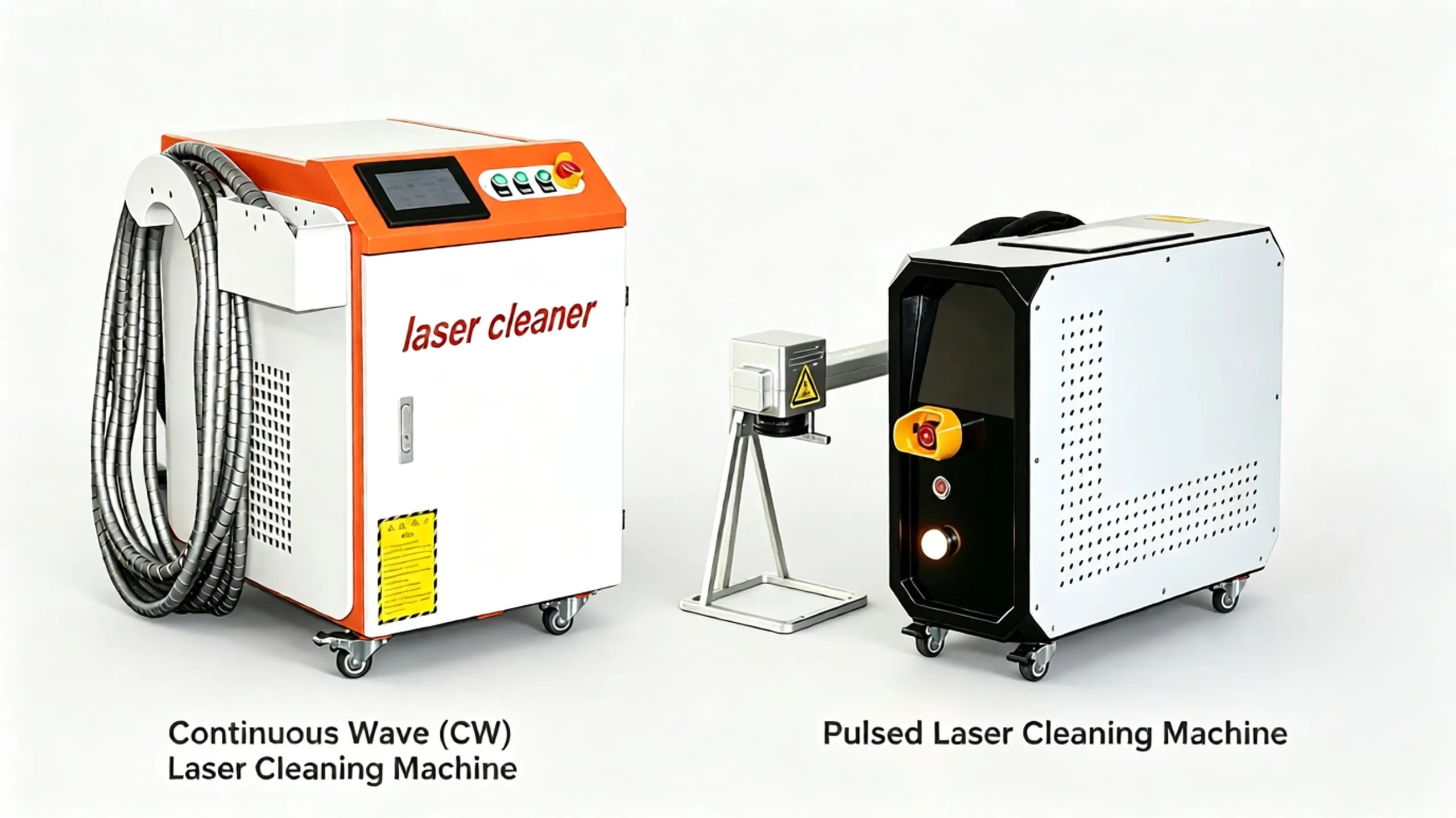
In laser cleaning, power isn’t everything. Taking a 3000 W continuous beam to a precision mold is like fixing a watch with a hammer—you’ll strip the contaminant and ruin the base geometry. Match the energy delivery to the substrate: compact pulsed systems for tight tolerances and delicate surfaces; high‑power CW for square‑meter throughput on heavy steel.
Engineers care about results on real parts, not slogans. Below is a practical comparison rooted in what actually happens at the surface, so you can choose a source that protects your parts and meets your takt time.
1. Introduction: Peak Power vs. Uninterrupted Heat Energy
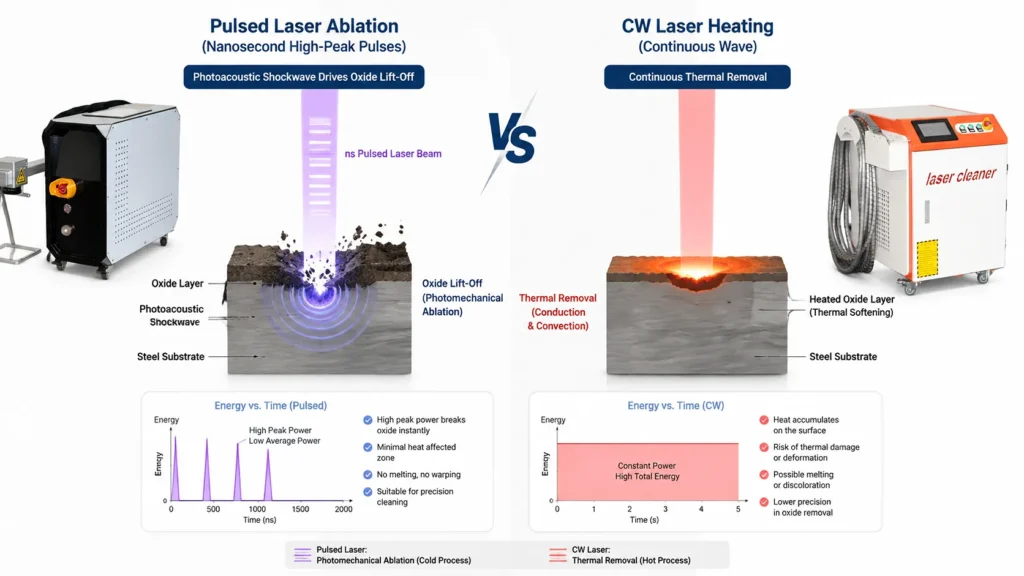
- Pulsed laser cleaning concentrates energy into nanosecond bursts with very high peak power (typically 10–500 ns). The energy density spikes above the ablation threshold, ejecting contaminants while the short duration limits heat flow into the base metal.
- CW laser cleaning delivers a steady beam. With higher average power (kilowatt-class), it excels at rapid removal of thick rust and scale across large areas where speed outweighs fine feature preservation.
- Rule of thumb: choose pulsed for precision surfaces and thin substrates; choose CW for fast processing on robust structures.
2. Operating Physics: How Pulse Energy and CW Beams Interact with Materials
- Pulsed ablation (nanosecond regime, ~10–500 ns):
- High peak irradiance triggers rapid surface absorption in coatings, oxides, and contaminants.
- Core mechanism: photoacoustic shockwave and micro-plasma pressure eject the layer; the contaminant is flash-heated and vaporized locally, then mechanically driven off by the shock front—without long-duration thermal soak.
- Because each pulse is nanoseconds long, heat has minimal time to diffuse into the substrate, reducing edge rounding and preserving micro-texture.
- CW removal:
- Continuous input raises surface temperature steadily.
- Thick oxides, heavy paint, and scale are driven off by sustained heating and plume ejection.
- Throughput can be very high, but thermal diffusion increases; on thin or delicate surfaces this risks discoloration, warping, or unwanted roughness.
Practical implications:
- For pulsed systems, pulse width (ns), peak power, repetition rate (kHz), and spot size define the ablation threshold, shock intensity, and depth-per-pass.
- For CW, average power, scan speed, and overlap control removal rate and total heat input. Tune for productivity on robust substrates.
3. When Precision Comes First: Why Compact Pulsed Lasers Dominate Delicate Substrates
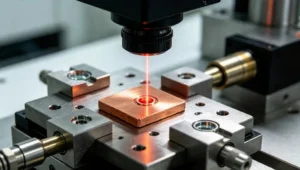
For tight tolerances and fine finishes, the target is to strip contamination without altering the base geometry or microstructure. Nanosecond pulses deliver a sharp energy spike that lifts the layer and ends before heat spreads.
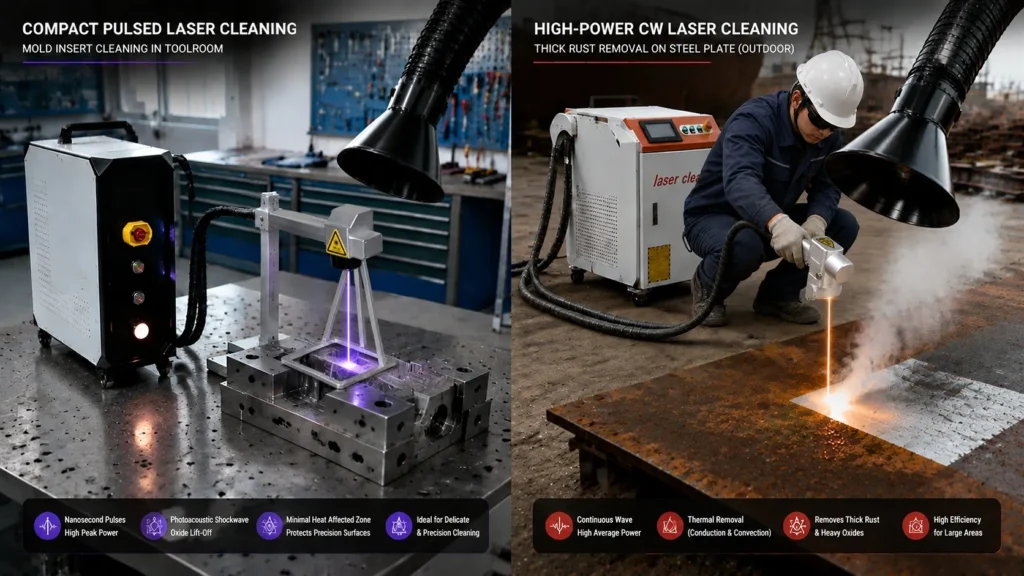
Injection Molds & Precision Tooling (Zero Edge Rounding or Tolerance Change)
- Keep parting lines sharp: Pulsed cleaning removes oxide, resin residues, and release agents without rounding edges or shifting dimensions.
- Preserve texture: Maintains EDM or micro-texture essential for part release and cosmetics.
- Localized work: Compact heads and precise scan control reach inserts and deep cavities with minimal collateral heating.
Automotive Restoration & Aerospace Components (Thin Sheet Metal & Alloy Skins)
- Thin panels: Lift paint, primers, and oxidation on hoods, doors, and alloy skins without oil-canning or distortion.
- Mixed materials: Safer around rivets, sealants, and adjacent composites when parameters are set for minimal HAZ.
- Surface prep: Clean bonding/adhesive areas without leaving grit or residues.
Historic Artifacts, Stone & Statuary Restoration
- Controlled removal: Strip biological growths, soot, and overpaint while preserving patina, inscriptions, and surface tooling marks.
- Low mechanical stress: No grit impact; reduces risk to carvings and delicate stonework.
Delicate Wood Surface & Varnish Stripping (Without Scorching)
- Finish refresh: Remove oxidized varnish or surface contaminants while avoiding charring by using low fluence, tight focus, and fast scanning.
- Detail-safe: Nanosecond pulses enable cleaning near joinery, inlays, and fine details within a narrow thermal window.
4. When Speed Is King: Why High-Power Continuous Wave (CW) Rules Heavy Fabrication
If the job is measured in square meters on thick substrates, continuous heat typically wins on throughput.
Heavy Structural Steel & Infrastructure
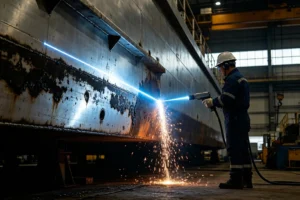
- Bridges, shipyards, heavy frames: Rapid removal of thick rust and scale ahead of coating or welding.
- Rugged surfaces: Higher thermal loads are acceptable without dimensional risk.
Large-Scale Heavy Rust & Mill Scale Removal
- Pre-paint prep: Clean wide areas faster than many blasting operations, with no media cleanup.
- High duty cycles: Kilowatt-class beams and wide scan heads maximize square meters per hour.
Pipeline & Storage Tank Maintenance
- Coating removal: Strip aged coatings and corrosion for inspection and recoating.
- Field productivity: Stable, continuous output outdoors with proper guarding and fume extraction.
5. Architectural Comparison: 200W–300W Compact Pulsed vs. 3000W CW Laser Cleaners
| Parameter | 200–300 W Compact Pulsed Cleaner | 3000 W CW Laser Cleaner |
|---|---|---|
| Energy Delivery | Nanosecond pulses with high peak power (10–500 ns) | Continuous, uninterrupted beam |
| Best For | Precision surfaces, thin substrates, high-value parts | Large areas, heavy rust/mill scale, thick steel |
| Heat Input to Substrate | Low; tight thermal confinement | Higher; greater thermal diffusion |
| Typical Removal Rate | Moderate; tuned for control and finish | High; tuned for throughput |
| Edge/Feature Preservation | Excellent (zero edge rounding focus) | Limited on fine features |
| Typical Use Environments | Toolrooms, restoration studios, electronics and mold shops | Shipyards, infrastructure, heavy fabrication yards |
| Footprint & Power | Compact, lower electrical demand | Larger power requirements, heavier chiller |
| Operator Skill | Parameter finesse for delicate work | Process setup for speed and safety on large surfaces |
6. Decision Matrix: Match Your Workpiece to the Right Laser Source
Ask these questions before you commit:
- Substrate thickness and value?
- Thin, high-value parts with critical geometry → Compact Pulsed.
- Thick, robust structures needing fast turnaround → CW.
- Contaminant type and thickness?
- Light oxidation, paints, shop residues → Pulsed for fine control.
- Heavy rust, mill scale, thick coatings → CW for rapid removal.
- Required finish after cleaning?
- Preserve texture, edges, and cosmetic surfaces → Pulsed.
- Pre-weld or pre-coat prep where finishing happens later → CW.
- Deployment environment?
- Toolroom, museum, studio, small cells → Pulsed.
- Yards, bridges, tanks, pipelines → CW.
- Takt time and labor model?
- Short-run, high-precision, mixed parts → Pulsed reduces rework risk.
- Large-area production cleaning → CW maximizes square meters per hour.
Quick field rules:
- If a machinist worries about losing a sharp edge, choose Pulsed.
- If the crew measures progress in square meters per shift, choose CW.
- Mixed fleets make sense: Pulsed for fine zones and edges; CW for bulk stripping.
7. Scale Your Cleaning Capabilities with ONSLASER
At ONS LASER, we build compact nanosecond pulsed cleaners alongside high‑power CW systems. Bring us your parts and coatings—we’ll run them in our lab and share parameters your operators can use on day one.
- Direct Factory Pricing & OEM/ODM
- Built on our own lines with no middleman. Custom optics, scan heads, enclosures, and software tailored to your workflow.
- Local German Warehouse & Hub
- Duty‑paid stock, fast EU shipping, and a German showroom for live demos and hands‑on cleaning trials.
- 100% Pre-Calibrated & Ready to Run
- Shipped fully assembled and optically aligned. From crate to cleaning in under 10 minutes.
- Full Laser Spectrum Expertise
- Fiber, MOPA, CO2, UV, and YAG in‑house. Unbiased matching between pulsed and CW cleaners for your materials and contaminants.
Ready to verify on real workpieces? Send samples to our application lab for a no‑cost cleaning trial with before/after microscopy, removal rate data, and a parameter sheet tuned to your substrates.
Contact ONSLASER Application Engineers for Free Testing & Quote